GLP-1 Research

Published research summaries and educational context for GLP-1 receptor agonists including semaglutide, tirzepatide, and related compounds.

Scientific illustration representing a semaglutide lifespan study in older female mice
GLP-1 Research

Semaglutide Lifespan Study: Older Mice Lived Longer in New Nature Research

A new Nature study has placed semaglutide in the longevity conversation. Researchers found that treatment begun in 20-month-old female mice extended median lifespan from 742 to 834 days while improving physical function, glucose control, exploratory behavior, spatial memory, stem-cell activity, inflammation, and several molecular markers associated with aging. The findings are striking, but they remain animal data—not evidence that people should take semaglutide for life extension.


Scientific illustration of a 2026 GLP-1 safety study examining semaglutide and liraglutide outcomes across the brain, gastrointestinal tract, liver, pancreas, and eyes.
GLP-1 Research

GLP-1 Safety Study 2026 Finds New Signals for Semaglutide and Liraglutide

A new multicentre cohort study published in 2026 detected several safety signals among people starting semaglutide or liraglutide for weight management, including psychiatric, gastrointestinal, liver, pancreatobiliary, and vision outcomes. The findings deserve attention, but they are associations from electronic-health-record data—not proof that GLP-1 medicines caused the events.

Scientific illustration representing survodutide dual GLP-1 and glucagon receptor signaling in a phase 3 obesity trial
GLP-1 Research, Research News

Survodutide Phase 3 Results: The GLP-1/Glucagon Dual Agonist Explained

In the phase 3 SYNCHRONIZE-1 trial, the investigational GLP-1/glucagon dual agonist survodutide produced significantly greater weight loss than placebo in adults with obesity without diabetes. The findings do not establish superiority over semaglutide or tirzepatide, but they provide important late-stage evidence on efficacy and gastrointestinal tolerability.

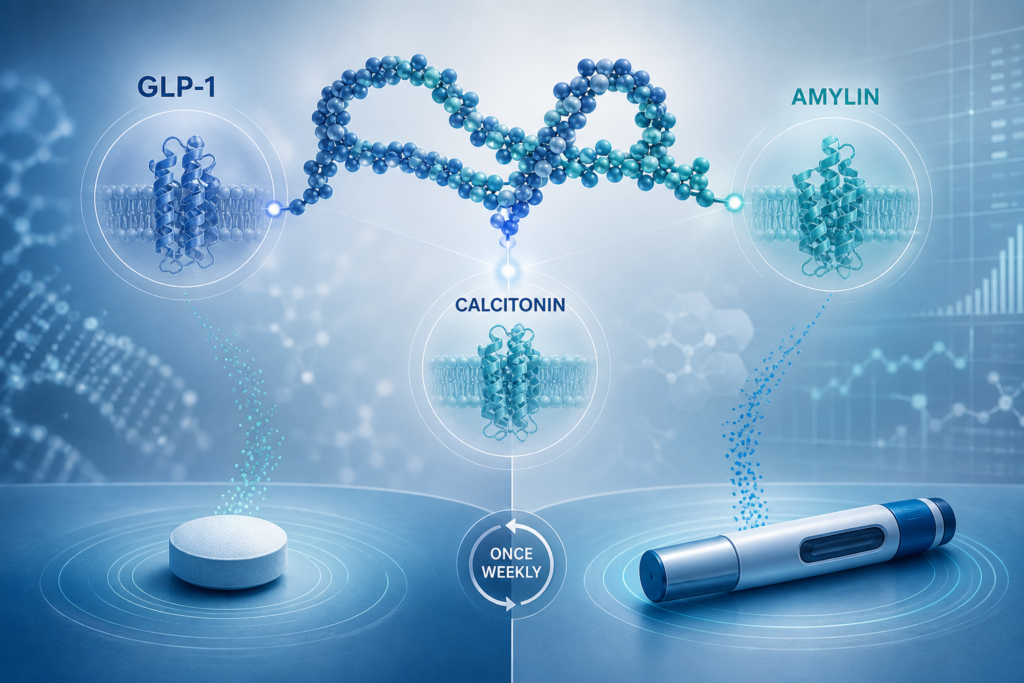
Scientific illustration of zenagamtide phase 2 research showing oral and weekly formulations connected to GLP-1, amylin, and calcitonin-receptor-related pathways
GLP-1 Research, Peptide Research

Zenagamtide Phase 2 Results: Amycretin’s Oral and Weekly Forms Enter a New Stage

New peer-reviewed zenagamtide phase 2 results update the former amycretin program with separate oral and once-weekly studies in adults with type 2 diabetes. The findings show glucose-lowering activity and primarily gastrointestinal adverse events, while a registered phase 3 obesity study is designed to compare weekly zenagamtide with semaglutide.

Research Tools
Scroll to Top