GLP-1 Research

Published research summaries and educational context for GLP-1 receptor agonists including semaglutide, tirzepatide, and related compounds.

Scientific illustration of the setmelanotide hypothalamic obesity trial correction and MC4 receptor pathway
GLP-1 Research

Setmelanotide Hypothalamic Obesity Trial Correction: What Changed

A New England Journal of Medicine correction published October 14, 2026 changes how the TRANSCEND setmelanotide trial should be read. The correction aligns the published record with the FDA review of all 142 randomized participants, revises the placebo-adjusted BMI difference, and reports two deaths rather than one. The update does not erase the efficacy signal, but it adds important context about rare-disease evidence and safety interpretation.

Illustration of the EVOKE semaglutide Alzheimer’s disease clinical trial results
GLP-1 Research

Semaglutide Alzheimer’s Trial Results: What EVOKE Found

The largest clinical test of a GLP-1 drug in Alzheimer’s disease has now answered an important question. In the EVOKE and EVOKE+ phase 3 trials, oral semaglutide did not significantly slow cognitive or functional decline in 3,808 adults with early, amyloid-confirmed Alzheimer’s disease. The findings separate promising metabolic and laboratory signals from proven clinical benefit and reshape the next phase of GLP-1 brain research.

Illustration of the HD1916 chemically synthesized semaglutide phase 3 trial compared with reference semaglutide
GLP-1 Research

HD1916 Semaglutide Trial: What Phase 3 Results Mean

A randomized phase 3 trial published October 7, 2026 found that chemically synthesized semaglutide HD1916 produced weight loss within its therapeutic-equivalence margin compared with reference semaglutide. The 462-person Chinese trial is important for follow-on GLP-1 development, but it does not establish FDA approval, interchangeability, long-term safety, or suitability of unapproved products.

Illustration representing the phase 3 survodutide type 2 diabetes trial and its weight and HbA1c findings
GLP-1 Research

Survodutide Type 2 Diabetes Trial: What SYNCHRONIZE-2 Found

The October 1, 2026 publication of SYNCHRONIZE-2 provides the first detailed phase 3 results for survodutide in adults with both type 2 diabetes and overweight or obesity. In 752 participants treated for 76 weeks, the investigational glucagon/GLP-1 dual agonist produced greater weight loss and HbA1c reductions than placebo. The results add late-stage evidence while showing why tolerability, treatment persistence, cardiovascular outcomes, and head-to-head comparisons remain important unanswered questions.

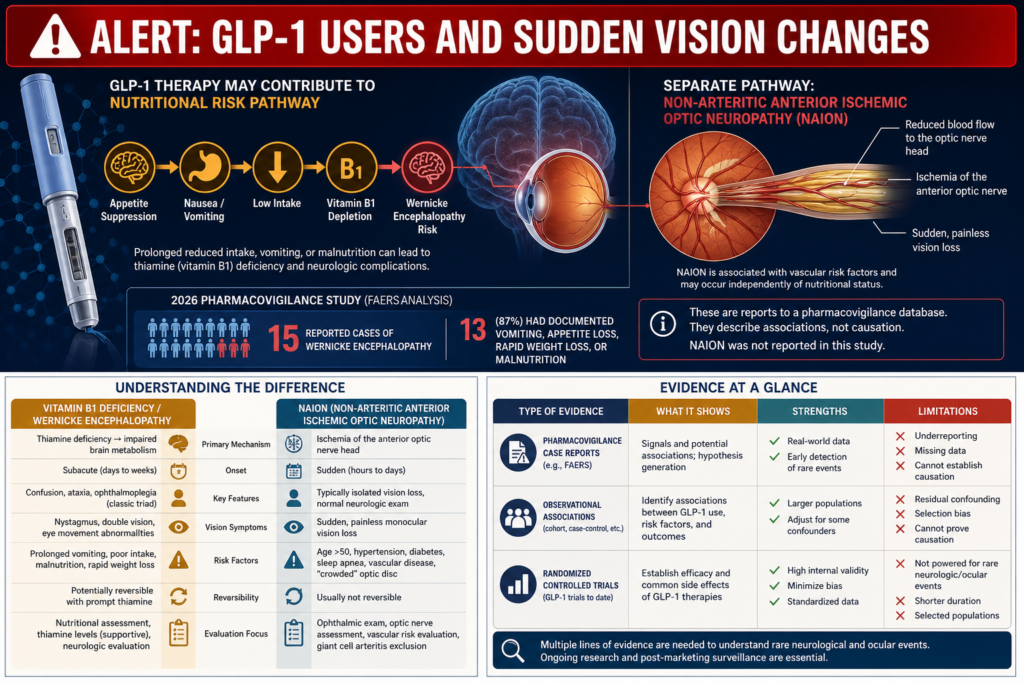
Alert graphic explaining vitamin B1 deficiency, Wernicke encephalopathy, NAION, and vision concerns in GLP-1 users
GLP-1 Research

Vitamin B1 Deficiency and Vision Loss in GLP-1 Users: What the New Evidence Shows

The phrase “GLP-1s cause blindness” combines two different safety questions. New 2026 evidence describes a rare but serious vitamin B1 deficiency pathway involving prolonged vomiting, inadequate food intake, rapid weight loss, and Wernicke encephalopathy. Separate studies and regulator warnings address NAION, a rare optic-nerve disorder associated most consistently with semaglutide. This evidence review explains what is known, what is not proven, and why sudden vision changes require urgent medical evaluation.

Illustration of petrelintide amylin biology and the ZUPREME-1 Phase 2 obesity trial
GLP-1 Research

Petrelintide Phase 2 Trial: What ZUPREME-1 Found

The ZUPREME-1 Phase 2 publication reports that the investigational once-weekly amylin analogue petrelintide produced up to 10.7% mean weight loss at week 42 versus 1.7% with placebo in 493 adults with obesity or overweight. The placebo-controlled trial also reported nausea more often with petrelintide, while direct comparisons with GLP-1 medicines remain unavailable.

Illustration explaining phase 3 retatrutide obesity trial results and triple-receptor biology
GLP-1 Research

Retatrutide Phase 3 Obesity Trial: What TRIUMPH-1 Shows

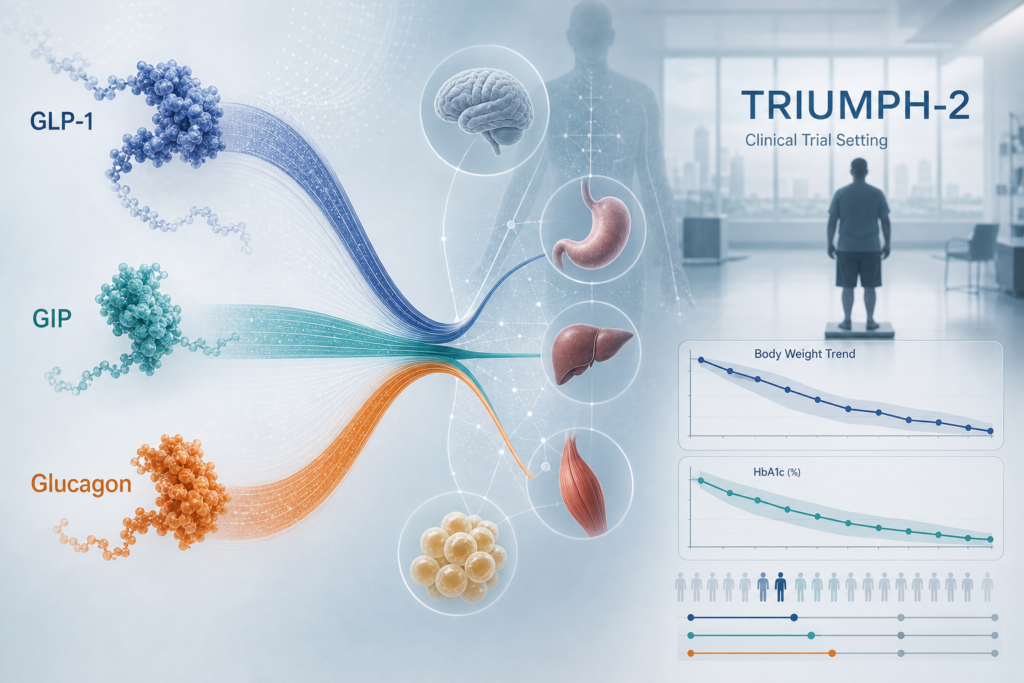
The September 29, 2026 New England Journal of Medicine publication of TRIUMPH-1 provides the first detailed peer-reviewed phase 3 results for retatrutide in obesity. In 2,339 adults without diabetes, the investigational triple agonist produced dose-dependent weight loss over 80 weeks, while prespecified subgroups reported improvements in knee osteoarthritis pain and obstructive sleep apnea. The findings are substantial, but they do not establish FDA approval, long-term cardiovascular benefit, or superiority over approved medicines in a head-to-head trial.

Research Tools
Scroll to Top