
Research articles on GLP-1 medicines, peptides, nootropics, laboratory education, and grey-market quality are collected here in one current library. Browse by topic, read the latest publication cards, and expand the research context section when you want the evidence standards and editorial approach behind the summaries. Every article is educational research reference material—not medical advice, a treatment recommendation, or a substitute for a qualified clinician or the original study.
Latest research articles
-
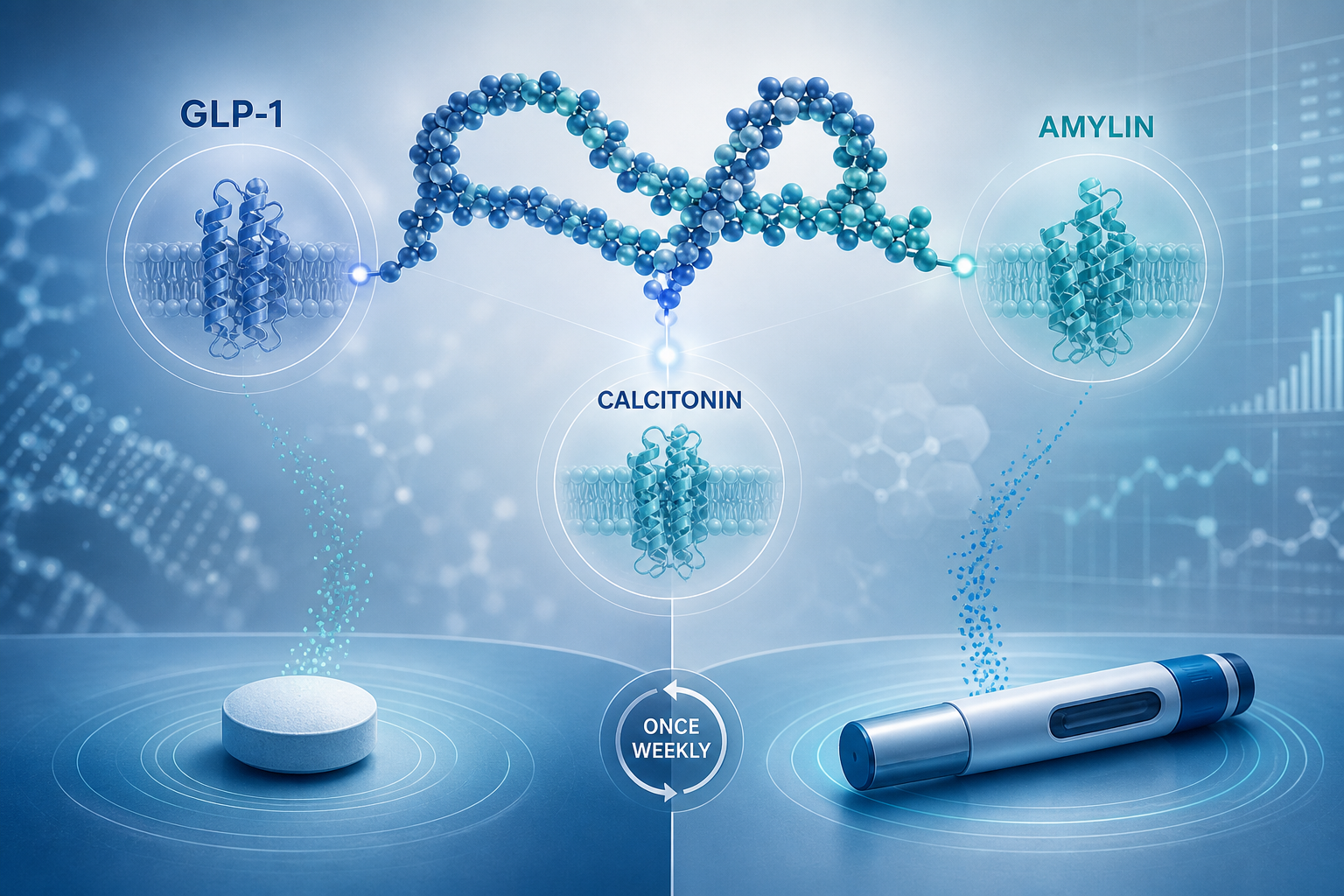
Zenagamtide Phase 2 Results: Amycretin’s Oral and Weekly Forms Enter a New Stage
New peer-reviewed zenagamtide phase 2 results update the former amycretin program with separate oral and once-weekly studies in adults with type 2 diabetes. The findings show glucose-lowering activity and primarily gastrointestinal adverse events, while a registered phase 3 obesity study is designed to compare weekly zenagamtide with semaglutide.
-
Yale Just Overturned an Assumption About How Ozempic Actually Works
A new Yale/PNAS study finds GLP-1 drugs recruit hunger-driving AgRP neurons rather than suppress them — overturning a long-held assumption and revealing a sex-specific mechanism that could reshape future obesity drug design.
-

mRNA-LNP Obesity Therapy: How Targeted RNA Could Move Beyond GLP-1 Injections
A new research direction could eventually change how obesity medicines are designed: instead of repeatedly injecting a finished peptide or protein, mRNA-LNP systems may deliver genetic instructions directly to metabolic tissues. Recent peer-reviewed work describes adipose-targeted lipid nanoparticles carrying GLP-1/FGF21 mRNA, while a new Nature Reviews Endocrinology perspective frames the field as a potential route…
-

VCT220 Oral GLP-1 Trial: What the Phase 2 Results Mean
A peer-reviewed phase 2 study published August 14, 2026, adds VCT220 to the growing field of oral, nonpeptide GLP-1 receptor agonists. In 250 Chinese adults with overweight or obesity, once-daily VCT220 produced dose-dependent weight loss over 16 weeks, with the highest reported group reaching a 9.73% mean reduction from baseline compared with 1.61% for placebo.…
-
Fake Ozempic Is Already in the Supply Chain — Here’s How to Spot Counterfeit GLP-1s Before They Spot You
Counterfeit semaglutide and tirzepatide have shown up in the legitimate U.S. drug supply chain, in some cases laced with unapproved substances. Here’s exactly what to check before you trust a dose.
-
Retatrutide’s Knee Osteoarthritis Data Might Matter More Than the Weight Loss Numbers
TRIUMPH-4 didn’t just show record weight loss — it left more than 1 in 8 patients completely free of knee pain. Here’s what the osteoarthritis-specific trial data shows, separate from retatrutide’s weight-loss headline.
-
Your Compounded GLP-1 Just Got Riskier: A Patient Action Plan for the 2026 FDA Crackdown
If you’re on compounded semaglutide or tirzepatide, the regulatory ground is shifting under you. Here’s a concrete checklist for what to actually verify and ask before your next refill.
-

FDA Finds Toxic Yellow Oleander in Botanical Weight-Loss Products
The FDA’s August 12, 2026 update adds another botanical weight-loss product to its yellow oleander safety alert. Laboratory testing found that products marketed as tejocote root or other natural slimming aids contained toxic cardiac glycosides, and some also contained undeclared drugs or chemicals. Here is what the alert means, why yellow oleander is dangerous, how…
-

Retatrutide’s FDA Classification Fight Could Reshape Peptide Access
Eli Lilly’s August 2026 lawsuits against companies selling unauthorized retatrutide brought a deeper regulatory dispute back into focus: whether the investigational triple agonist should be classified by the FDA as a biologic or a conventional drug. That decision could influence its approval pathway, market exclusivity, compounding arguments, and how regulators treat future peptide medicines.
-

Fake COAs, No-Show Packages, and Vials With Nothing In Them: What the Peptide Community Is Actually Reporting About Scams
Search “peptide scam” on Reddit and you won’t find a single dramatic story. You’ll find dozens of small, tired, almost identically shaped ones: a payment that went through, a tracking number that never updated, a chatbot that couldn’t answer a direct question, and a customer who eventually gave up and called their credit card company…
Research context, evidence standards, and editorial approach

How to Use These Research Articles
Start with the topic links above to narrow the library, then open an article that matches your question. Compound profiles provide a quick orientation to names, mechanisms, research status, and linked literature, while full research articles explain study design, reported outcomes, and important limitations in more detail. Use publication dates and categories to understand context, and follow source links when you need to check the underlying paper, regulatory notice, or public record.
How We Read the Evidence
A finding in a randomized human trial does not carry the same weight as an observational association, an animal experiment, or an in-vitro result. When reading research articles, check the population, comparison group, sample size, follow-up period, measured endpoint, and whether the result was a primary or exploratory analysis. A plausible mechanism can explain why a compound is being studied, but it cannot establish human safety or efficacy by itself. We also separate approved medicines from investigational compounds and research-use-only materials so readers do not confuse biological interest with regulatory status.
Questions to Ask Before Drawing a Conclusion
- Was the study conducted in humans, animals, cells, or a laboratory model?
- Was there a control or comparison group, and was the study large enough to support the claim?
- Does the reported endpoint measure a meaningful outcome or only a short-term marker?
- Are the results peer reviewed, publicly registered, and reproducible?
- Does the article link to the primary source so the methods and limitations can be checked?
- What remains unknown, especially about long-term safety, product quality, or generalizability?
Editorial Approach and Primary Sources
GLP1Place aims to make technical research easier to follow without turning uncertain findings into promises. Articles identify whether evidence is clinical, observational, preclinical, mechanistic, or regulatory, and they use cautious language when a study cannot establish cause and effect. For primary literature, compare the article summary with PubMed research results and the original publication whenever a claim matters. Sources may change over time, so readers should verify current notices and consult qualified professionals for personal medical decisions.
Keeping Research Current
Research moves quickly, especially in obesity medicine, peptide science, cognitive research, and product-quality oversight. A newer paper may add context without overturning every earlier finding, while an agency alert or later correction can change how a claim should be understood. For that reason, this Blog page is organized as a living research library rather than a static list of conclusions. Check publication dates, read the most recent update when available, and treat headlines as a guide to the evidence—not as proof that a compound works, is safe, or is appropriate for a particular person. This page also connects related topics so readers can compare clinical research with preclinical studies and regulatory reporting in the same subject area.
Educational and research reference only: the information on GLP1Place is not medical advice, a diagnosis, or a treatment recommendation.
Use category archives to compare related reports and compound profiles; the date, category, and source context help explain how each item fits the broader research record. When a claim matters, start with the linked primary source and the relevant regulatory notice.