Author name: GLP1Place Research Team

Scientific illustration of a 2026 GLP-1 safety study examining semaglutide and liraglutide outcomes across the brain, gastrointestinal tract, liver, pancreas, and eyes.
GLP-1 Research

GLP-1 Safety Study 2026 Finds New Signals for Semaglutide and Liraglutide

A new multicentre cohort study published in 2026 detected several safety signals among people starting semaglutide or liraglutide for weight management, including psychiatric, gastrointestinal, liver, pancreatobiliary, and vision outcomes. The findings deserve attention, but they are associations from electronic-health-record data—not proof that GLP-1 medicines caused the events.

FDA peptide warning letters and research use only compliance documents
Grey Market Watch

FDA Peptide Warning Letters: RUO and Intended Use in 2026

Several FDA warning letters dated August 24, 2026 provide a detailed explanation of how the agency evaluates online peptide marketing. The letters address retatrutide, semaglutide, tirzepatide, survodutide, mazdutide, SS-31, tesamorelin, PT-141, and bacteriostatic water, showing why a research-use-only disclaimer may not overcome claims that imply human treatment or injection use.

FDA GLP-1 import alert and pharmaceutical API quality-control illustration
Grey Market Watch

FDA GLP-1 Import Alert Targets Adulterated APIs

The FDA’s August 21, 2026 revision to Import Alert 66-80 gives field offices authority to detain potentially adulterated GLP-1 active pharmaceutical ingredients without physical examination. The action is not a blanket ban on legal imports or all lawful compounding. FDA says it evaluated 48 GLP-1 API sites and found 21% noncompliant or insufficiently responsive to records requests. The alert covers semaglutide, tirzepatide, liraglutide, exenatide, dulaglutide, orforglipron, and broader peptide, hormone, and antidiabetic classifications.

Scientific illustration representing survodutide dual GLP-1 and glucagon receptor signaling in a phase 3 obesity trial
GLP-1 Research, Research News

Survodutide Phase 3 Results: The GLP-1/Glucagon Dual Agonist Explained

In the phase 3 SYNCHRONIZE-1 trial, the investigational GLP-1/glucagon dual agonist survodutide produced significantly greater weight loss than placebo in adults with obesity without diabetes. The findings do not establish superiority over semaglutide or tirzepatide, but they provide important late-stage evidence on efficacy and gastrointestinal tolerability.

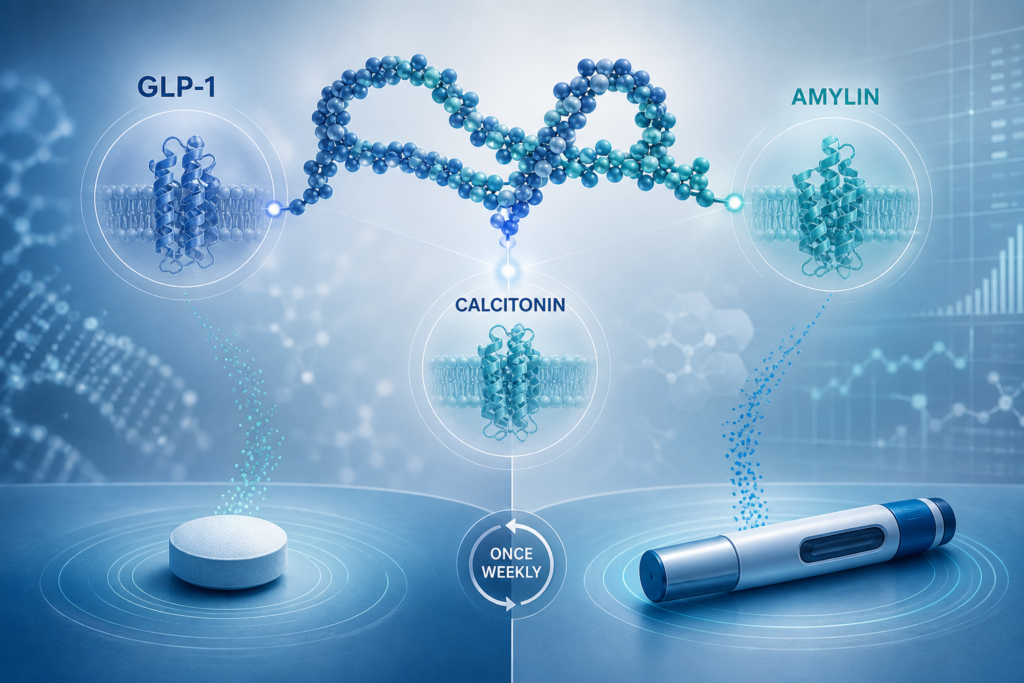
Scientific illustration of zenagamtide phase 2 research showing oral and weekly formulations connected to GLP-1, amylin, and calcitonin-receptor-related pathways
GLP-1 Research, Peptide Research

Zenagamtide Phase 2 Results: Amycretin’s Oral and Weekly Forms Enter a New Stage

New peer-reviewed zenagamtide phase 2 results update the former amycretin program with separate oral and once-weekly studies in adults with type 2 diabetes. The findings show glucose-lowering activity and primarily gastrointestinal adverse events, while a registered phase 3 obesity study is designed to compare weekly zenagamtide with semaglutide.

Illustration of mRNA lipid nanoparticles delivering GLP-1 and FGF21 instructions to adipose tissue
Research News

mRNA-LNP Obesity Therapy: How Targeted RNA Could Move Beyond GLP-1 Injections

A new research direction could eventually change how obesity medicines are designed: instead of repeatedly injecting a finished peptide or protein, mRNA-LNP systems may deliver genetic instructions directly to metabolic tissues. Recent peer-reviewed work describes adipose-targeted lipid nanoparticles carrying GLP-1/FGF21 mRNA, while a new Nature Reviews Endocrinology perspective frames the field as a potential route toward longer-lasting, programmable metabolic therapy. The science is promising but remains entirely preclinical for obesity, with major questions around delivery, repeat dosing, immune effects, manufacturing, and translation to humans.

Editorial illustration of the VCT220 oral GLP-1 phase 2 obesity trial and its dose-dependent weight-loss findings
GLP-1 Research

VCT220 Oral GLP-1 Trial: What the Phase 2 Results Mean

A peer-reviewed phase 2 study published August 14, 2026, adds VCT220 to the growing field of oral, nonpeptide GLP-1 receptor agonists. In 250 Chinese adults with overweight or obesity, once-daily VCT220 produced dose-dependent weight loss over 16 weeks, with the highest reported group reaching a 9.73% mean reduction from baseline compared with 1.61% for placebo. The results are important because VCT220 is designed to be taken orally without the absorption constraints associated with oral semaglutide, but the study remains short, geographically limited, and insufficient to establish long-term efficacy or safety.

FDA warning about toxic yellow oleander found in botanical weight-loss products
Grey Market Watch

FDA Finds Toxic Yellow Oleander in Botanical Weight-Loss Products

The FDA’s August 12, 2026 update adds another botanical weight-loss product to its yellow oleander safety alert. Laboratory testing found that products marketed as tejocote root or other natural slimming aids contained toxic cardiac glycosides, and some also contained undeclared drugs or chemicals. Here is what the alert means, why yellow oleander is dangerous, how the contamination happens, and what researchers and regulators are watching next.

Research Tools
Scroll to Top