Growth hormone (GH) and insulin-like growth factor 1 (IGF-1) are central regulators of muscle protein synthesis, recovery from exercise, and body composition. The research literature on compounds that modulate GH/IGF-1 signaling is substantial — and includes both pharmaceutical-grade clinical trials and RUO peptide research. This overview specifically addresses muscle, recovery, growth hormone research, and related research is indexed on PubMed.
The GH/IGF-1 Axis and Muscle Biology
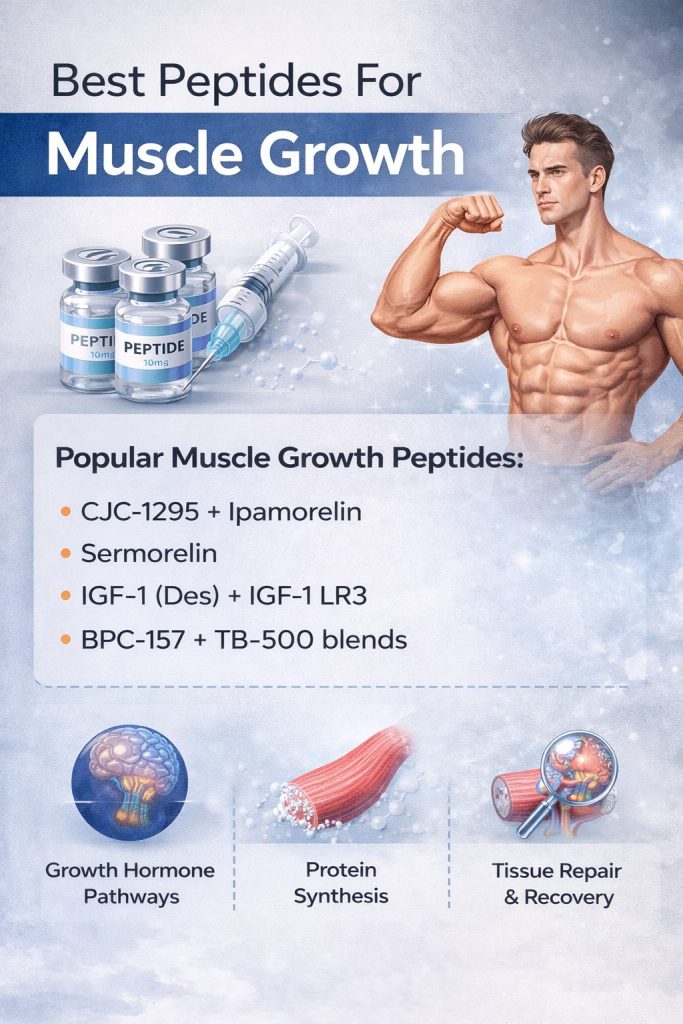
Growth hormone is secreted by the anterior pituitary in pulsatile bursts, with highest pulses during slow-wave sleep. GH stimulates hepatic production of IGF-1, which acts on skeletal muscle to increase amino acid uptake, stimulate protein synthesis, inhibit protein degradation (anti-catabolic), and promote satellite cell proliferation (muscle stem cells). This axis naturally declines with age — a phenomenon sometimes called somatopause — which has motivated research into compounds that can restore or enhance GH signaling.
GHRH Analogs: CJC-1295 and Sermorelin
Sermorelin is a synthetic fragment of GHRH (growth hormone-releasing hormone) — specifically the first 29 amino acids. It has a regulatory history: it was FDA-approved for pediatric GH deficiency (withdrawn from market for commercial reasons, not safety). Published clinical trials documented its ability to stimulate pulsatile GH release and increase IGF-1 levels in GH-deficient patients.
CJC-1295 is a modified GHRH analog with DAC (Drug Affinity Complex) that extends its half-life from minutes (native GHRH) to approximately 8 days. A Phase II clinical trial published in the Journal of Clinical Endocrinology and Metabolism reported that CJC-1295 produced dose-dependent increases in GH and IGF-1 levels in healthy adults.
GHRPs: Ipamorelin, GHRP-2, GHRP-6
Growth hormone-releasing peptides act on ghrelin receptors (GHS-R1a) to stimulate GH release. They work through a different pathway than GHRH analogs, and their effects are additive when combined with GHRH analogs. Key differentiating factor: GHRP-6 and GHRP-2 co-stimulate cortisol and prolactin release alongside GH. Ipamorelin was designed to be more selective, with published research demonstrating minimal cortisol/prolactin co-stimulation at effective GH-releasing doses. See the Ipamorelin and CJC-1295 compound profiles.
MK-677 (Ibutamoren)
MK-677 is an oral, non-peptide ghrelin mimetic studied in multiple clinical trials. Published data from Merck-sponsored trials established its ability to significantly increase GH and IGF-1 levels with once-daily oral dosing. A two-year study in elderly subjects demonstrated lean mass increases with long-term use. MK-677 is one of the better-studied compounds in this category in humans, though it remains a research compound without FDA approval. See the MK-677 compound profile.
Secretagogues vs. Exogenous GH: A Fundamentally Different Approach
It’s worth being precise about a distinction often blurred in casual discussion: GH secretagogues (like ipamorelin, CJC-1295, sermorelin, and MK-677) do not directly supply growth hormone. Instead, they stimulate the pituitary gland’s own GH-releasing mechanisms — either mimicking GHRH (growth hormone releasing hormone) or acting on the ghrelin/GH secretagogue receptor — meaning the body’s natural pulsatile secretion pattern and negative feedback regulation remain intact. Recombinant human growth hormone (rHGH), by contrast, is exogenous GH administered directly, bypassing pituitary regulation entirely and producing sustained, non-pulsatile elevated GH levels. This distinction is proposed as a safety rationale for secretagogues (that natural feedback loops limit how high GH can rise) but is not the same as saying secretagogues are risk-free — sustained receptor stimulation from repeated secretagogue use is itself an active area of safety research, and this distinction shouldn’t be read as certainty about long-term safety.
Real Risks Documented in the Literature
Both approaches to GH-axis modulation carry documented risk profiles worth stating plainly. Elevated GH/IGF-1 signaling (whether from secretagogues or exogenous GH) has been associated in research with insulin resistance and elevated blood glucose (GH opposes insulin action on glucose uptake), fluid retention and joint/soft-tissue swelling, carpal tunnel-like symptoms, and — a concern specific to MK-677 given its ghrelin-receptor activity — increased appetite that can complicate body-composition goals. Long-term data on cardiovascular and cancer-risk outcomes from sustained non-medical GH-axis modulation remains limited, since most controlled human trials in this space have run for months rather than years or decades.
Frequently Asked Questions
Are GH secretagogues inherently safer than exogenous growth hormone?
They operate through a mechanistically different pathway (stimulating natural pulsatile release rather than bypassing it), which is often cited as a safety rationale, but this has not been established as definitively safer in long-term human outcomes — both approaches carry documented risks that should be weighed on their own evidence, not assumed away by mechanism alone.
Does combining a GHRH analog (like CJC-1295) with a ghrelin-mimetic (like ipamorelin) work better than either alone?
This combination is commonly discussed based on the rationale that the two act on different receptors with potentially additive pulsatile GH release, but direct head-to-head human trial data comparing the combination against either compound alone is limited.
Why does GH modulation affect blood sugar?
Growth hormone has a physiological role in opposing insulin’s glucose-lowering action (part of its normal counter-regulatory function), which is why elevated GH or IGF-1 signaling — from any source — is associated with insulin resistance and requires monitoring in research contexts involving glucose-sensitive individuals.
Research reference only. GH-modulating compounds carry significant risk profiles in misuse contexts and are not approved for performance enhancement. Not medical advice.