Grey Market Watch

Enforcement news, scam patterns, China supply-chain reporting, and quality-control guidance for the research peptide grey market.

Counterfeit retatrutide vial beside a liver injury warning and laboratory testing results
Grey Market Watch

Counterfeit Retatrutide Linked to Liver Injury: What the Australian Safety Alert Means

A cluster of seven acute liver-injury cases in Victoria has become one of the clearest recent warnings about the danger of counterfeit retatrutide. The products were sold outside regulated medical channels and may not have contained clinical-trial retatrutide at all. New testing also found major discrepancies between the labeled and measured contents of black-market vials, reinforcing the difference between a promising investigational compound and an unverified product sold under its name.

Illustration showing doctor impersonation and GLP-1 prescription fraud risks
Grey Market Watch

GLP-1 Prescription Fraud: Doctor Impersonation Scheme Exposes a New Access Risk

A federal indictment announced August 17, 2026 alleges that an Illinois man impersonated physicians, misused National Provider Identifier information, and helped customers obtain GLP-1 and other prescription medications without legitimate authorization. The case shows how grey-market risk can extend beyond counterfeit products into prescription fraud, identity theft, and pharmacy-benefit abuse.

FDA injectable glutathione endotoxin warning and sterile compounding safety illustration
Grey Market Watch

Injectable Glutathione Endotoxin Warning: What the FDA Alert Reveals About Compounding Quality

A new FDA safety alert tied at least 30 adverse-event reports to compounded intravenous glutathione made with dietary-supplement-grade material. The warning exposes a broader quality problem: an ingredient suitable for oral supplement manufacturing is not automatically suitable for sterile injection. Here is what the August 2026 alert, related recalls, and endotoxin science mean for compounding oversight and consumer awareness.

FDA peptide warning letters and research use only compliance documents
Grey Market Watch

FDA Peptide Warning Letters: RUO and Intended Use in 2026

Several FDA warning letters dated August 24, 2026 provide a detailed explanation of how the agency evaluates online peptide marketing. The letters address retatrutide, semaglutide, tirzepatide, survodutide, mazdutide, SS-31, tesamorelin, PT-141, and bacteriostatic water, showing why a research-use-only disclaimer may not overcome claims that imply human treatment or injection use.

FDA GLP-1 import alert and pharmaceutical API quality-control illustration
Grey Market Watch

FDA GLP-1 Import Alert Targets Adulterated APIs

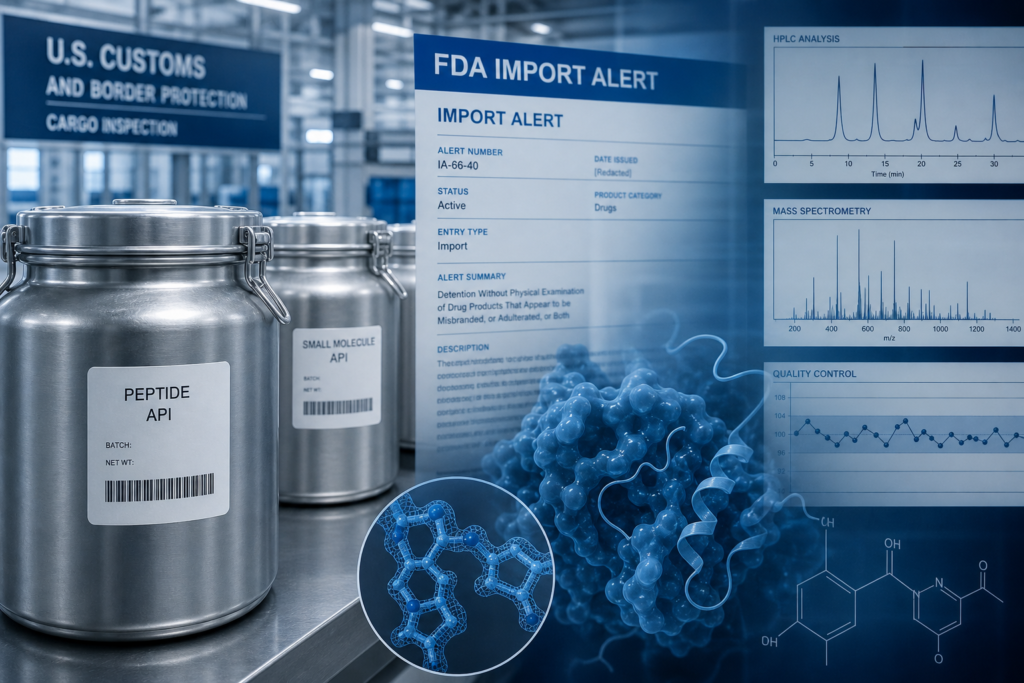
The FDA’s August 21, 2026 revision to Import Alert 66-80 gives field offices authority to detain potentially adulterated GLP-1 active pharmaceutical ingredients without physical examination. The action is not a blanket ban on legal imports or all lawful compounding. FDA says it evaluated 48 GLP-1 API sites and found 21% noncompliant or insufficiently responsive to records requests. The alert covers semaglutide, tirzepatide, liraglutide, exenatide, dulaglutide, orforglipron, and broader peptide, hormone, and antidiabetic classifications.

Retatrutide FDA classification dispute involving biologic and conventional drug pathways
Grey Market Watch

Retatrutide’s FDA Classification Fight Could Reshape Peptide Access

Eli Lilly’s August 2026 lawsuits against companies selling unauthorized retatrutide brought a deeper regulatory dispute back into focus: whether the investigational triple agonist should be classified by the FDA as a biologic or a conventional drug. That decision could influence its approval pathway, market exclusivity, compounding arguments, and how regulators treat future peptide medicines.

FDA warning about toxic yellow oleander found in botanical weight-loss products
Grey Market Watch

FDA Finds Toxic Yellow Oleander in Botanical Weight-Loss Products

The FDA’s August 12, 2026 update adds another botanical weight-loss product to its yellow oleander safety alert. Laboratory testing found that products marketed as tejocote root or other natural slimming aids contained toxic cardiac glycosides, and some also contained undeclared drugs or chemicals. Here is what the alert means, why yellow oleander is dangerous, how the contamination happens, and what researchers and regulators are watching next.

Research Tools
Scroll to Top