Peptide “stacking” — using multiple research compounds simultaneously — is widely discussed in biohacking and research communities, but rarely examined through a rigorous mechanistic lens. This article looks at the research rationale for combining the three most-discussed categories: tissue repair peptides (BPC-157, TB-500), GH secretagogues (Ipamorelin, CJC-1295), and what the published science actually supports. This overview specifically addresses peptide stacking research, and related research is indexed on PubMed.
The Complementary Mechanism Argument
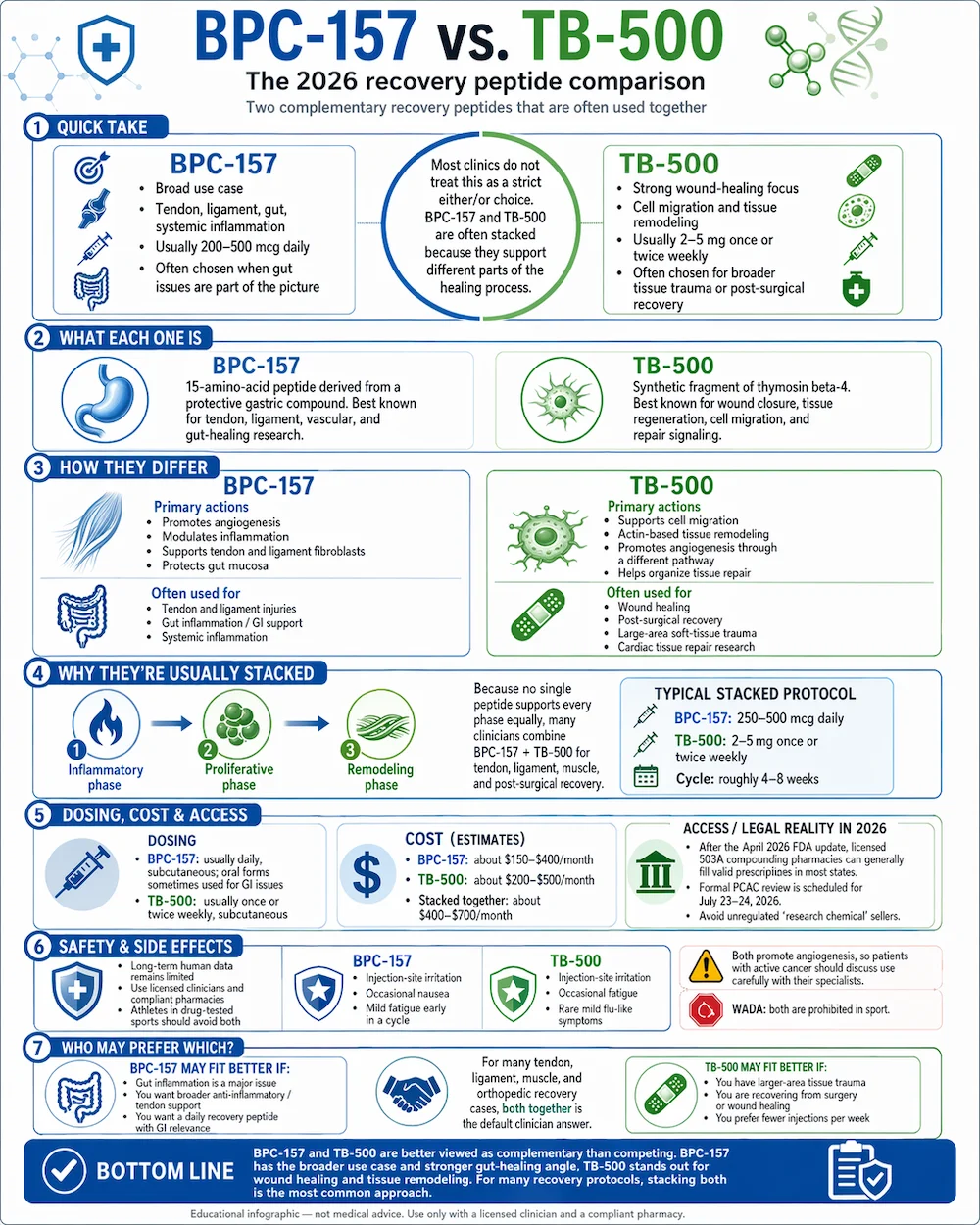
The core argument for combining these categories is that they work through non-overlapping pathways:
- BPC-157: Acts primarily through local tissue mechanisms — nitric oxide modulation, growth factor upregulation (VEGF, EGF receptor), and direct cytoprotective effects. Does not require GH/IGF-1 signaling.
- TB-500: Acts through actin-sequestration, cell migration promotion, and angiogenesis. Also largely GH-independent.
- GH secretagogues (Ipamorelin + CJC-1295): Stimulate pulsatile GH release → elevated IGF-1 → systemic anabolic and repair effects through IGF-1 receptor signaling in muscle, bone, and connective tissue.
The mechanistic rationale is that local tissue repair (BPC-157/TB-500) plus systemic anabolic signaling (GH axis) might produce additive effects on tissue recovery. This is biologically plausible but largely undemonstrated in controlled combination studies.
What the Published Combination Research Shows
Honest answer: almost nothing. Direct combination studies for these specific compounds are nearly absent from peer-reviewed literature. What exists:
- Rodent studies combining BPC-157 with growth hormone (not secretagogues) in tendon and bone models — some showing additive effects on healing markers
- No published RCT or controlled study combining Ipamorelin + CJC-1295 + BPC-157 in any species
- The combination rationale is extrapolated from individual compound data and pathway biology
This is an important gap to acknowledge: the community rationale is mechanistically reasonable but lacks empirical combination validation.
GH Axis and Tissue Repair: The Established Connection
What IS well-established is that GH/IGF-1 signaling plays a major role in tissue repair. GH-deficient individuals (and GH-deficient animal models) show impaired wound healing, reduced collagen synthesis, and slower fracture repair. Restoring GH signaling restores these functions. This forms the legitimate basis for research interest in GH secretagogues in recovery contexts.
Published literature on exogenous GH (not secretagogues) in injury recovery is substantial, including data on tendon repair, muscle satellite cell activation, and bone fracture healing in both animal models and humans (primarily GH-deficient patient populations).
Research Considerations When Combining
From a pure research design perspective, combining multiple variables makes it impossible to attribute effects to specific compounds. Researchers interested in studying these compounds rigorously typically study them individually with proper controls. The “stack” approach is more pragmatic than scientific in that sense.
Key unknowns for any combination: pharmacokinetic interactions, receptor cross-talk, potential pathway competition, optimal timing, and whether combination truly outperforms individual compound use. These questions remain unanswered in the published literature.
Why Combining Compounds Multiplies Uncertainty, Not Just Effects
Each individual compound in a stack already carries its own evidence-quality caveats (preclinical vs. human data, single-lab vs. replicated findings, RUO sourcing variability). Combining compounds doesn’t just add their individual effects — it multiplies the number of unknowns. If BPC-157 sourcing carries a documented risk of purity variability across vendors, and TB-500 sourcing carries a separate risk of fragment-versus-full-length ambiguity, and a GH secretagogue carries its own dosing-response uncertainty, a person combining all three is now managing three independent sourcing risks and an unknown number of potential interaction effects simultaneously — with no published research characterizing what, if anything, changes when these specific compounds are used together rather than alone.
The Economic Incentive Problem
It’s worth noting plainly that “stacking” is also a commercially convenient narrative for sellers, since it increases the number of products a single customer purchases. This doesn’t mean every stacking discussion is commercially motivated, but it’s a relevant piece of context when evaluating enthusiastic claims about synergistic effects that lack a published evidence base — the incentive to promote combination use exists independent of whether combination use actually produces superior outcomes.
What Legitimate Combination Research Actually Looks Like
Where combination therapy research does exist in adjacent fields (for example, combining GLP-1 and GIP receptor agonism in tirzepatide, or combining GLP-1 agonism with amylin agonism in newer investigational drugs), it was developed through dedicated dose-ranging trials specifically designed to characterize the combined pharmacology, not through informal community protocols layering compounds with unrelated individual research histories. This is a useful benchmark for what “evidence-based stacking” actually requires: purpose-built trials studying the specific combination, not extrapolation from separately conducted single-compound studies.
Frequently Asked Questions
Does combining tissue-repair peptides with GH secretagogues have published research support?
No dedicated trials studying this specific combination have been published. The rationale rests on inferring compatibility from separately studied individual compounds, which is a weaker form of evidence than a purpose-built combination trial.
Why are combination protocols so commonly discussed if the evidence is this thin?
Community enthusiasm, anecdotal reporting, and commercial incentives (selling multiple products) all contribute to how often stacking is discussed, independent of how well-supported it is by published research.
How does dual-agonist drug development (like tirzepatide) differ from community stacking?
Approved dual/multi-agonist drugs go through dedicated trials designed specifically to characterize the combined mechanism and dose-response — a fundamentally different evidence standard than layering separately studied compounds based on informal protocols.
Educational content only. Not a protocol recommendation or medical advice. Research peptides are for laboratory research use only. Always refer to published literature when designing research.