Reconstitution is one of the most fundamental concepts in peptide research — and one of the most frequently misunderstood. This is a complete educational reference covering the process, the math, and the storage considerations. This overview specifically addresses understanding peptide reconstitution, and related research is indexed on PubMed.
What Is Reconstitution?
Lyophilization (freeze-drying) is the standard preservation method for research peptides because peptides in powder form are far more stable than in solution. Reconstitution is the process of dissolving that powder into a sterile liquid carrier to create an injectable solution.
The process is straightforward but must be done correctly to avoid degrading the peptide or contaminating the solution.
Why Bacteriostatic Water?
Bacteriostatic water (BAC water) is sterile water containing 0.9% benzyl alcohol as a preservative. The benzyl alcohol inhibits bacterial growth, extending the stability of a reconstituted peptide solution to approximately 28-30 days refrigerated.
Alternatives and when they’re used:
- Sterile water for injection (SWFI): No preservative — reconstituted solution should be used within 24 hours. Used when benzyl alcohol is contraindicated.
- Acetic acid solution (0.1% – 1.0%): Used for peptides that are poorly soluble at neutral pH (e.g., IGF-1, some growth factors). Helps with dissolution.
- Saline (0.9% NaCl): Generally avoided for peptides — osmotic effects can affect peptide stability in some cases.
The Reconstitution Process
Step-by-step educational reference:
- Clean all surfaces and wash hands thoroughly
- Clean the rubber stopper of the peptide vial with an alcohol swab and allow to dry
- Clean the rubber stopper of the BAC water vial with a fresh alcohol swab
- Draw the desired volume of BAC water using a sterile syringe
- Insert the needle into the peptide vial and inject the water slowly, directing the stream down the side of the vial wall — NOT directly onto the powder pellet (this can denature some peptides)
- Do not shake — gently swirl or roll the vial until fully dissolved. Most peptides dissolve within 60-90 seconds.
- Label the vial with compound name, concentration, reconstitution date, and expiry date
- Store refrigerated at 2-8°C, away from light
Concentration Math
This is the core calculation for any reconstituted peptide:
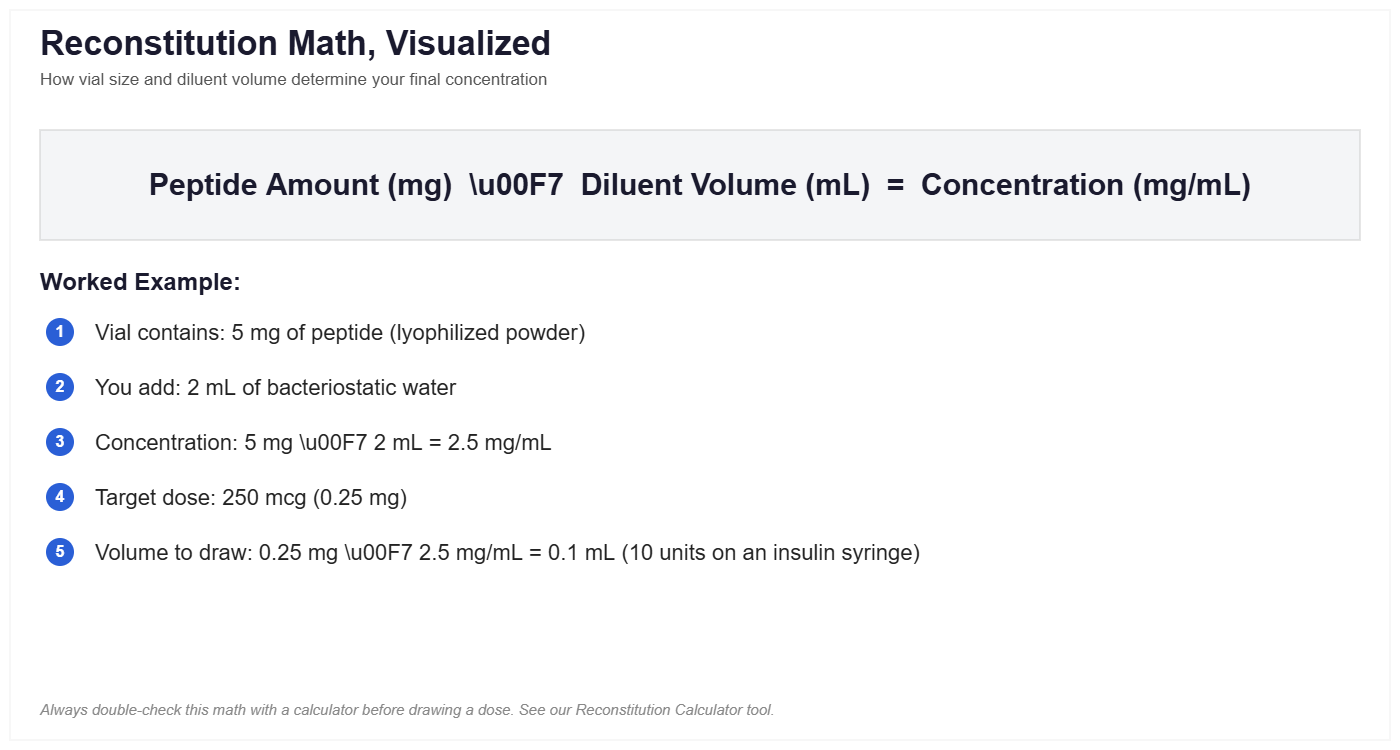
Concentration (mg/mL) = Peptide amount (mg) ÷ Volume of water added (mL)
Examples:
- 5mg peptide + 2mL BAC water = 2.5 mg/mL
- 5mg peptide + 2.5mL BAC water = 2.0 mg/mL
- 10mg peptide + 2mL BAC water = 5.0 mg/mL
U-100 Syringe Units to Volume Conversion
U-100 insulin syringes are calibrated with 100 units = 1 mL. This makes the conversion simple:
- 10 units = 0.1 mL
- 20 units = 0.2 mL
- 50 units = 0.5 mL
So if your concentration is 2.0 mg/mL and your reference dose (from published research) is 250mcg (0.25mg):
Volume needed = 0.25mg ÷ 2.0 mg/mL = 0.125 mL = 12.5 units on a U-100 syringe
Storage Guidelines
- Unreconstituted (lyophilized) peptide: -20°C or colder for long-term storage (months to years); refrigerator (2-8°C) is acceptable for short-term (weeks). Avoid repeated freeze-thaw cycles.
- Reconstituted peptide: Refrigerate at 2-8°C. Use within 28-30 days for BAC water preparations, 24 hours for SWFI preparations.
- Light exposure: Peptides can degrade with UV exposure. Store in amber vials or wrapped in foil when possible.
- Temperature: Never leave reconstituted peptide at room temperature for extended periods. Do not microwave or heat.
Worked Concentration Math Example
The core calculation everyone eventually needs: given a vial’s peptide amount and the volume of water added, what concentration results, and what syringe volume corresponds to a specific dose? Take a 5mg vial reconstituted with 2mL of bacteriostatic water as a worked example. Concentration = total peptide amount ÷ total liquid volume = 5mg ÷ 2mL = 2.5mg/mL. If a research protocol calls for a 250mcg (0.25mg) amount, the volume to draw = desired amount ÷ concentration = 0.25mg ÷ 2.5mg/mL = 0.1mL. Since most standard insulin syringes are marked in “units” where 100 units = 1mL (on a standard U-100 syringe), 0.1mL corresponds to 10 units on the syringe markings — this unit-to-mL conversion is where most practical confusion and calculation errors actually occur, since the syringe markings are a volume proxy, not a peptide-mass unit, and the conversion factor changes if a different syringe size (U-40, for instance, which uses a different unit-to-mL ratio) is used instead.
Why the Water Volume You Choose Is a Deliberate Trade-off
There’s no single “correct” amount of bacteriostatic water to add — it’s a trade-off between practical dosing precision and total usable solution volume. Adding less water creates a more concentrated solution, meaning very small syringe volumes are needed per dose (harder to measure precisely on a syringe’s markings, especially for very small target doses). Adding more water creates a more dilute solution, meaning larger, easier-to-measure syringe volumes per dose, but a bulkier total volume to store and a lower concentration that may require larger injection volumes than desired for some administration routes. Choosing a reconstitution volume that puts the intended dose in a syringe-readable range (commonly 10-50 units on a standard U-100 insulin syringe) is the practical goal behind this calculation, not an arbitrary preference.
Frequently Asked Questions
What’s the difference between a U-100 and U-40 syringe, and why does it matter for dosing math?
U-100 syringes are calibrated so that 100 unit-markings equal 1mL; U-40 syringes (less common, historically associated with certain insulin concentrations) use a different unit-to-volume ratio. Using the wrong syringe-type assumption in a volume-to-units conversion will produce an incorrect dose, which is why confirming syringe type is a necessary first step in any dosing calculation, not an afterthought.
Does using more or less reconstitution water change the total amount of peptide in the vial?
No — the total peptide mass in the vial is fixed regardless of how much liquid is added; only the concentration (amount per unit volume) changes, which in turn changes what syringe volume corresponds to a given dose.
Is there a tool that does this math automatically?
Yes — see our Reconstitution Calculator, which performs this concentration and syringe-unit conversion directly rather than requiring manual calculation each time.
Common Mistakes
- Injecting BAC water directly onto the powder pellet with force (can denature the peptide)
- Shaking vigorously instead of gentle swirling
- Not cleaning stoppers before each needle insertion
- Using the same syringe to both add water and draw doses (introduces contamination)
- Storing reconstituted peptide in a vial that has been penetrated many times (rubber stopper integrity degrades)
- Losing track of reconstitution date — always label immediately
This is educational content for research purposes only. Not medical advice, not dosing guidance, not a recommendation to use any peptide compound.