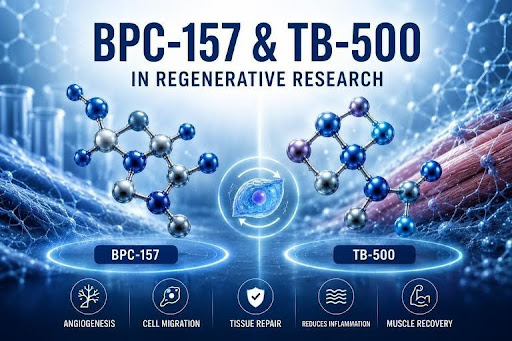
Musculoskeletal research represents one of the most developed areas of peptide science, with multiple compounds showing consistent effects on tissue repair in rodent models. This is a research overview of the compounds most studied for joint and connective tissue applications. This overview specifically addresses peptide therapy for joint health, and related research is indexed on PubMed.
Peptide Therapy for Joint Health: Why Joints and Tendons Are Difficult to Heal
Cartilage, tendons, and ligaments have notoriously poor healing capacity compared to bone and muscle. The reasons are well-understood: these tissues are avascular (minimal blood supply), have low cell turnover, and produce limited growth factors in response to injury. This creates a genuine unmet need that peptide research is attempting to address.
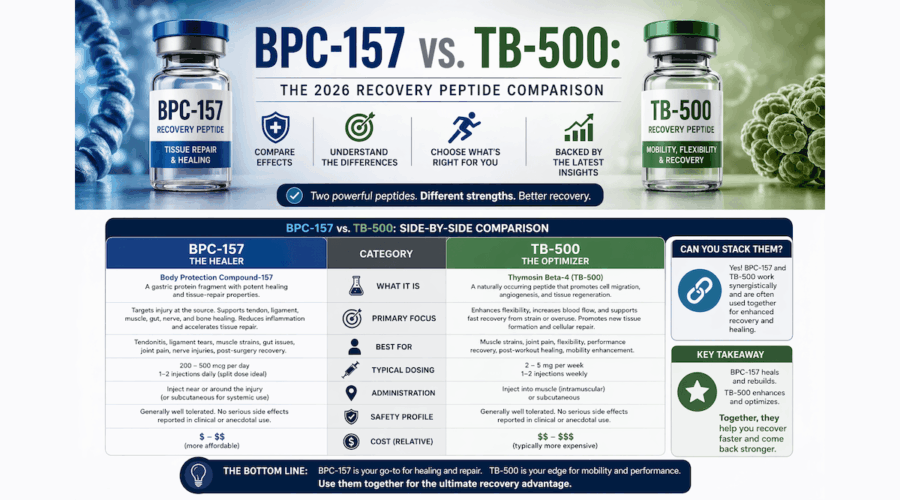
BPC-157 in Musculoskeletal Research
BPC-157 has the largest body of published musculoskeletal data of any research peptide. Key findings from the literature:
- Tendon healing: A frequently cited 2010 paper in the Journal of Physiology (Zagreb) showed BPC-157 significantly accelerated Achilles tendon healing in rats following surgical transection — including faster tensile strength recovery
- Ligament repair: Similar data exists for medial collateral ligament (MCL) healing in rat models
- Cartilage: Less studied, but some evidence of chondroprotective effects in osteoarthritis rat models
- Muscle: Studies showing accelerated recovery from crush injury and contusion in rodent models
The proposed mechanism involves upregulation of growth factor signaling (particularly VEGF and EGF receptor), enhanced fibroblast migration to injury sites, and nitric oxide modulation improving local blood flow to hypovascular tissues.
TB-500 in Musculoskeletal Research
TB-500 (Thymosin Beta-4) complements BPC-157 via different mechanisms. Key musculoskeletal findings:
- Accelerated muscle fiber regeneration after injury in rodent models — primarily through promotion of myoblast migration and differentiation
- Reduced fibrosis (scar tissue formation) in healing muscle, potentially improving functional recovery quality
- Tendon and ligament healing data exists but is less extensive than for BPC-157
Collagen Peptides: The Human Data
Oral hydrolyzed collagen peptides are the only category in this space with meaningful human clinical data for musculoskeletal outcomes:
- A 2019 RCT in British Journal of Nutrition showed collagen hydrolysate (15g/day) combined with exercise produced significant improvements in joint pain scores in athletes with activity-related joint pain vs placebo + exercise
- Published evidence for tendon collagen synthesis improvement in humans with specific collagen + vitamin C protocols (Shaw et al., American Journal of Clinical Nutrition, 2017)
- Consistent evidence that collagen peptides accumulate in cartilage tissue after oral supplementation (Oesser et al.)
The Human Data Gap
The key limitation for BPC-157 and TB-500 in musculoskeletal applications: despite extensive and consistent rodent data, no human controlled trials exist for either compound in musculoskeletal applications. The translation gap from rat tendon to human tendon is real and not guaranteed — human tendon biology, scale, and injury context differ substantially from rodent models.
Hydrolyzed Collagen vs. Undenatured Type II Collagen: Different Mechanisms Entirely
“Collagen supplement” is often treated as a single category, but two distinct products with different proposed mechanisms dominate the joint-health market. Hydrolyzed collagen (collagen peptides) is broken down into small peptide fragments intended to be absorbed and, per the Oesser research cited above, potentially accumulate in cartilage tissue where they may stimulate chondrocyte (cartilage cell) activity directly. Undenatured type II collagen (UC-II), by contrast, is administered in its native, non-hydrolyzed form specifically because the mechanism proposed for it is different: oral tolerance, an immune-modulation effect where small amounts of intact collagen exposed to gut-associated lymphoid tissue are theorized to reduce the immune system’s inflammatory response to the body’s own joint collagen. These are mechanistically unrelated hypotheses (direct tissue-building signaling versus immune modulation) packaged under similar “collagen for joints” marketing, and conflating them obscures which specific evidence base applies to which specific product.
What Human Osteoarthritis Trials Actually Show for Collagen
Randomized controlled trials of hydrolyzed collagen in osteoarthritis patients have generally reported modest but statistically significant improvements in pain scores and functional measures over placebo across periods of roughly 3-6 months, with effect sizes generally smaller than those seen with prescription anti-inflammatory approaches but with a considerably more favorable long-term safety profile given collagen’s status as a food-derived supplement rather than a pharmaceutical with GI or cardiovascular risk considerations. This puts collagen’s human evidence base in a very different category than BPC-157 or TB-500’s rodent-only data — it’s a real, if modest, effect demonstrated in actual human osteoarthritis patients rather than an extrapolation from animal tendon-injury models.
The Glucosamine/Chondroitin Cautionary Tale
It’s worth noting the joint-supplement category’s history of disappointing large-trial results, since it’s directly relevant context for evaluating newer entrants. Glucosamine and chondroitin — long the dominant joint supplements — were put through the large, NIH-funded GAIT trial, which found no statistically significant benefit over placebo for the overall study population, despite decades of smaller studies and strong market popularity suggesting otherwise. This history is a useful caution: popularity, plausible mechanism, and positive small studies don’t reliably predict what a large, well-controlled trial will find, and it’s a standard worth holding newer joint-health compounds (including BPC-157 and TB-500) to as their evidence base develops.
Frequently Asked Questions
Is hydrolyzed collagen the same as undenatured type II collagen?
No — they’re different products with different proposed mechanisms (direct tissue-building signaling vs. immune-tolerance modulation), despite both being marketed under general “collagen for joints” branding.
Does collagen actually help with joint pain based on human trials?
Human RCTs generally show modest but statistically significant improvements in pain and function over placebo, which is meaningfully more human evidence than exists for BPC-157 or TB-500 in this application, though the effect size is smaller than prescription options.
What does glucosamine/chondroitin’s history teach us about newer joint compounds?
The large NIH-funded GAIT trial found no significant benefit despite years of smaller studies and strong popularity — a reminder that rigorous large-trial data can overturn what smaller studies and market enthusiasm suggested, a standard worth applying to newer compounds too.
Educational content. BPC-157 and TB-500 are research compounds without approved human applications for musculoskeletal use. Collagen peptides have the strongest human evidence in this category. Not medical advice.